 Visit Istanbul Guide
Hagia Sophia
The Hagia Sophia is the sixth-century church that became a mosque, then a museum, then a mosque again, and since 2024 it has sold visitors a ticket to its upper gallery while the floor below stays in use for prayer. This page covers the hours, the route, the mosaics and the cut-offs; the money questions sit on the Hagia Sophia tickets page. For the wider plan, including which sights need buying ahead and what the city costs, see what to see in Istanbul.
Quick answer Hours, price, what you actually get to see
The Hagia Sophia admits visitors daily 09:00–20:00, but the box office shuts at 19:00. Foreign visitors pay €25 (about $29) for the upper gallery; the ground floor is reserved for worship and is not part of the visit.
Key takeaways
- Every entry option and the ₺300 fast-track add-on are laid out on the Hagia Sophia tickets page
- A skip-the-line ticket removes the box-office queue, which is the part that catches people at 18:00
- Müzekart does not work here and neither does the €105 Museum Pass İstanbul — this is a separate ticket
- Visiting pauses around prayers, so plan around the day's prayer times, Friday midday above all
- The Blue Mosque is free and four minutes away across the park — do both in one morning
Key facts
Opening hours
| Daily, all year | 09:00–20:00 |
|---|---|
| Box office | 09:00–19:00 |
Closed No weekly closing day published; visiting pauses around Friday prayers
Admission
- Adult
- €25 for foreign visitors (about $29)
- Reduced
- Fast-track add-on ₺300 (about $6.20) on top of the ticket
- Free
- Türkiye citizens under 8; Müzekart is not valid here
Planning it
- Time needed
- Not stated by the museum; our routing: 45–60 minutes for the gallery and the narthex
- Book ahead
- Optional — walk-up usually fine
- Address
- Sultan Ahmet Mah., Ayasofya Meydanı No: 1, Fatih, Istanbul
What the ticket actually opens
Since the building returned to use as a mosque, the visit and the prayer hall are separated by floor. Knowing that before you arrive saves the disappointment people describe at the door.
The upper gallery
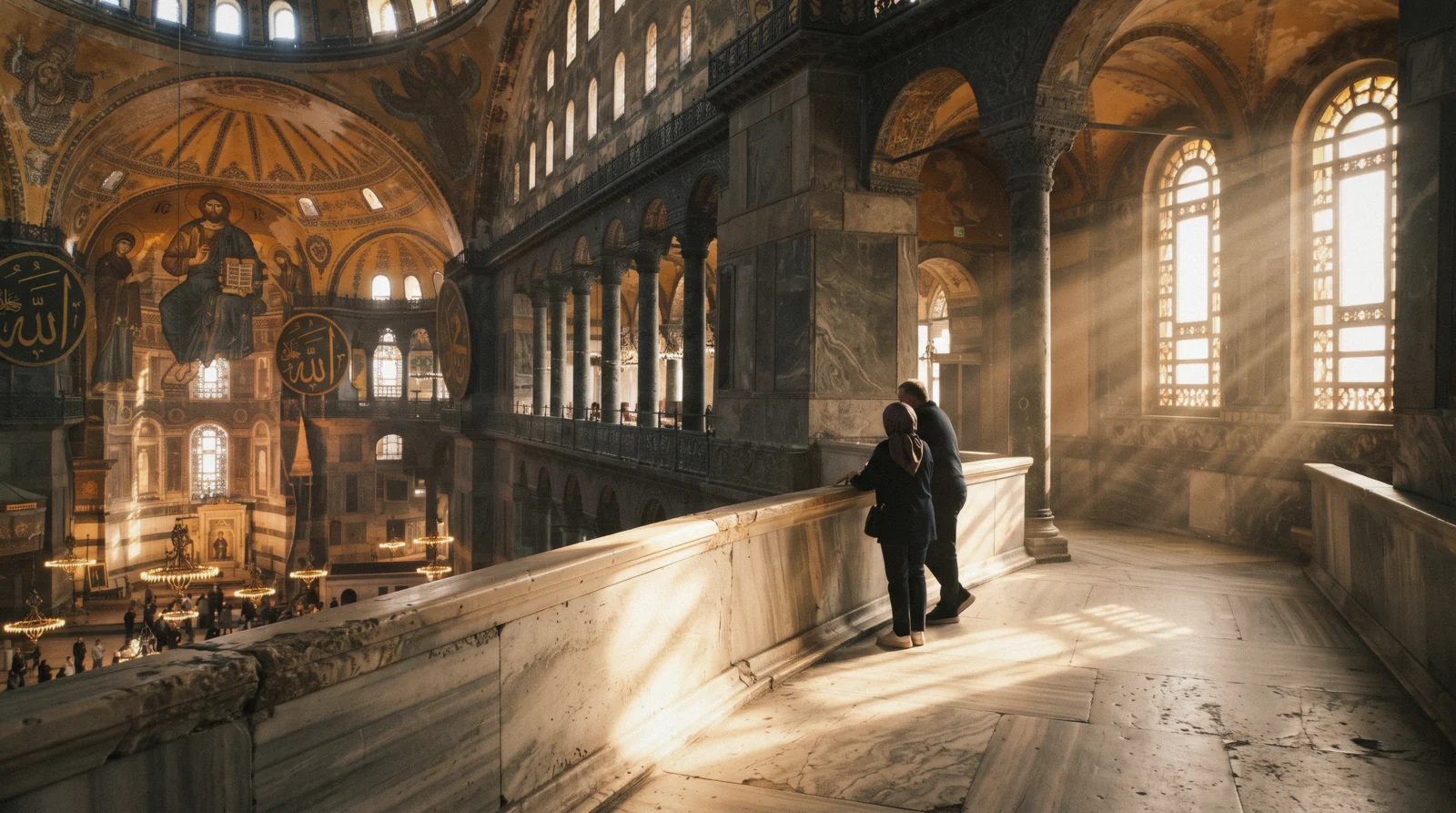
The ticket admits you to the gallery that runs around three sides of the nave, reached by a stone ramp rather than stairs — wide, worn and shallow, built for horses carrying the empress. From the south gallery you look down the full length of the nave and across at the calligraphic roundels. This is where the surviving figurative mosaics are, because they are the ones that sat above head height and out of reach.
The mosaics worth finding
Three matter. The Deesis, in the south gallery, is a thirteenth-century Christ flanked by the Virgin and John the Baptist, the faces modelled in tesserae so fine the surface reads as skin. A few metres away sit the Empress Zoe panel, whose husband's face was replaced twice as she remarried, and the Comnenus panel.
In the narthex below, the tenth-century mosaic over the Imperial Door shows an emperor prostrate before Christ.
What you cannot do
The nave floor is a prayer hall: it is carpeted, and visitors are not routed across it. Photography of people praying is not acceptable. The building admits visitors until 20:00 but sells nothing after 19:00, and during prayers — five a day, with Friday midday the longest — the visitor flow stops.
The Hagia Sophia in ten dates
Three churches have stood on this site and the current one has been a cathedral, a mosque, a museum and a mosque again. These are the dates that explain what you walk into.
-
360
The first church is consecrated
Under Constantius II, on 15 February — a timber-roofed basilica on the site, destroyed by fire in 404.
-
415
Theodosius II rebuilds
The second church is inaugurated on 10 October. Fragments of its monumental entrance are still on display in the forecourt.
-
532
The Nika riots burn it down
The second church is destroyed on 13–14 January; Justinian begins the third — the building standing today — on 23 February, five weeks later.
-
537
Justinian's church is inaugurated
On 27 December, five years and ten months after the fire. Its dome was the largest in the world for nearly a thousand years.
-
558–562
The dome comes down and goes back up higher
The eastern semi-dome collapses in 558 and is rebuilt twenty Byzantine feet higher, giving the interior height of about 55.6 m you stand under now.
-
1204
The Fourth Crusade sacks the city
The building is stripped and used as a Latin Catholic cathedral until Constantinople returns to Byzantine hands in 1261.
-
1317
The buttresses go on
Andronikos II orders the eastern and northern buttresses that still hold the building up — the reason its outside looks heavier than its inside.
-
1453
Mehmed II converts it to a mosque
On the day of the conquest. The figurative mosaics above head height survive because they were plastered rather than destroyed.
-
1935
It becomes a museum
By decree of the Turkish republic; the plaster comes off and the Byzantine mosaics are uncovered. UNESCO inscribes the Historic Areas of Istanbul in 1985.
-
2020, then 2024
A mosque again, then a gallery ticket
Reclassified as a working mosque in 2020, with the ground floor returned to prayer. Since 2024 foreign visitors buy a €25 ticket for the upper gallery — how the ticket is sold.
Sources: the chronology in Wikipedia's Hagia Sophia article, which cites the UNESCO inscription of the Historic Areas of Istanbul (1985); the ticket and hours from the Ministry of Culture's own museum page, muze.gov.tr, and the DÖSİM tariff sheet, both read on 2 September 2026.
How much time to give the Hagia Sophia
The museum publishes no visit length, so these are our three routings against the published hours: doors 09:00 to 20:00, box office shut at 19:00. The building is a single gallery circuit, so the difference between them is how long you stand still.
Every routing walks the same ramp and the same circuit — there is no shorter loop and no longer one. What changes is whether you give the Deesis and the narthex mosaic the minutes they need, and whether somebody is telling you what you are looking at.
| Routing | Inside | Door to door from Sultanahmet | What you skip |
|---|---|---|---|
| The gallery circuit, walking | 30 min | About 1 h with the shoe queue and the ramp | Time at the Deesis, and the narthex mosaic over the Imperial Door |
| The full route, this page's own | 45–60 min | About 1.5 h including the box office | Nothing — the ramp, the whole gallery, both mosaic groups, the narthex |
| Inside a guided three-sight walk | About 40 min | 3 h, with the Blue Mosque and the cistern | Your own pace, and the quiet 09:00 hour unless the tour starts there |
Whichever you take, the hour matters more than the length. Between 10:00 and 13:00 the ramp fills with coach groups and the gallery is a single circuit that cannot be walked around; the first hour and the two before the 19:00 cut-off are the ones with room to stop.
Getting there, and when to come
The T1 tram stops at Sultanahmet, two minutes from the door, on one İstanbulkart ride of ₺46.20 (about $0.96). From Taksim take the F1 funicular to Kabataş and the T1 from there.
The quiet hours are the first, 09:00 to 10:00, and the last two before the 19:00 cut-off. Between 10:00 and 13:00 the ramp fills with coach groups, and the gallery is a single circuit, so a crowd there cannot be walked around. Arrive after 18:00 and you may still get in; arrive after 19:00 and no ticket exists to buy at any price. Full transport detail on getting around Istanbul.
What to wear, and why it applies to visitors too
The Hagia Sophia is a working mosque, so the mosque code applies on the visitor route as well: shoulders and knees covered, hair covered for women, shoes off and carried. Scarves are available at the entrance. Jeans are fine, shorts are not, and flip-flops make the shoe rule awkward rather than impossible.
The full list, and what the other mosques expect, is on mosque etiquette.
Dos and don'ts at the Hagia Sophia
Everything argued above, compressed for the morning you go.
Do
- Arrive at 09:00 or after 18:00 — between 10:00 and 13:00 the ramp fills with coach groups and the gallery is a single circuit you cannot walk around
- Buy before 19:00, whatever the closing time says: the doors admit until 20:00 but no ticket is sold after the box office shuts
- Dress for a working mosque: shoulders and knees covered, hair covered for women, shoes off and carried — mosque etiquette has the full list
- Give the south gallery the time: the Deesis, the Empress Zoe panel and the Comnenus panel are all within a few metres of each other
- Look up on the way out — the tenth-century mosaic over the Imperial Door is in the narthex, below the gallery, and most people walk straight under it
- Pair it with the Blue Mosque, four minutes across the park and free
Don't
- Don't expect the floor: the nave is a carpeted prayer hall and the ticket admits you to the upper gallery only
- Don't photograph people praying, and don't treat the ground floor as part of the visit
- Don't turn up during Friday midday prayers, the longest pause of the week — check the day's prayer times first
- Don't arrive holding a Museum Pass İstanbul or a Müzekart expecting them to work; neither is valid here
- Don't pay the ₺300 fast-track add-on at 09:00 or after 18:00 — the queue it removes exists in the middle of the day, not at the ends of it
Five things most visitors do not know about the Hagia Sophia
Facts that change how the building reads, each with where it comes from.
- It is the third church on the site, and it was built in under six years. The Nika riots burned the second one on 13–14 January 532; Justinian started this one on 23 February and inaugurated it on 27 December 537. (Wikipedia, Hagia Sophia) - The dome you look at is not Justinian's first one. The eastern semi-dome collapsed in 558 and was rebuilt twenty Byzantine feet higher by 562, which is where the 55.6 m interior height comes from; the dome spans roughly 32.7 to 33.5 m. (Wikipedia, Hagia Sophia) - A Viking left graffiti in the gallery you are standing in. A runic inscription cut into a parapet of the upper gallery is listed among the building's notable features, most plausibly by a Varangian guardsman.
(Wikipedia, Hagia Sophia) - The heavy outside is a fourteenth-century repair. The buttresses propping the eastern and northern sections were ordered by Andronikos II Palaiologos in 1317, eight centuries after the church was finished. (Wikipedia, Hagia Sophia) - The euro price is the real price, and the lira one is derived from it. The ministry prices foreign entry at €25 and defines the Müzekart rate for Türkiye citizens as ₺625 — half the €25 fare converted at the day's rate — which is why the lira figure moves and the euro figure does not. (DÖSİM tariff sheet, dosim.ktb.gov.tr, read on 2 September 2026) A building this layered rewards context, so many visitors round off their Hagia Sophia visit with one of the guided tours in Istanbul that cover its dome, galleries, and buttresses together.
Eating at the gate
There is no café inside the visitor route, and the streets immediately outside are the weakest value in the city.
Nothing is sold inside the gallery circuit, so the question is where you eat before or after. The restaurants along Divan Yolu, directly outside, price for the tram stop rather than the food; walking one street back — toward Çemberlitaş or down toward Kumkapı — costs less and eats better, which is the same advice the Sultanahmet page gives about the whole quarter. The simit and roasted-chestnut carts on the square are the cheap, reliable option between two sights, and where to eat in Istanbul has the meals worth planning a day around.
These are our own observations rather than published prices, so they are labelled as such.
Entry options people book
Prices and ratings are the platform's own figures on 2 September 2026; the official €25 fare is in the freshness box above, so the margin is visible before you click.
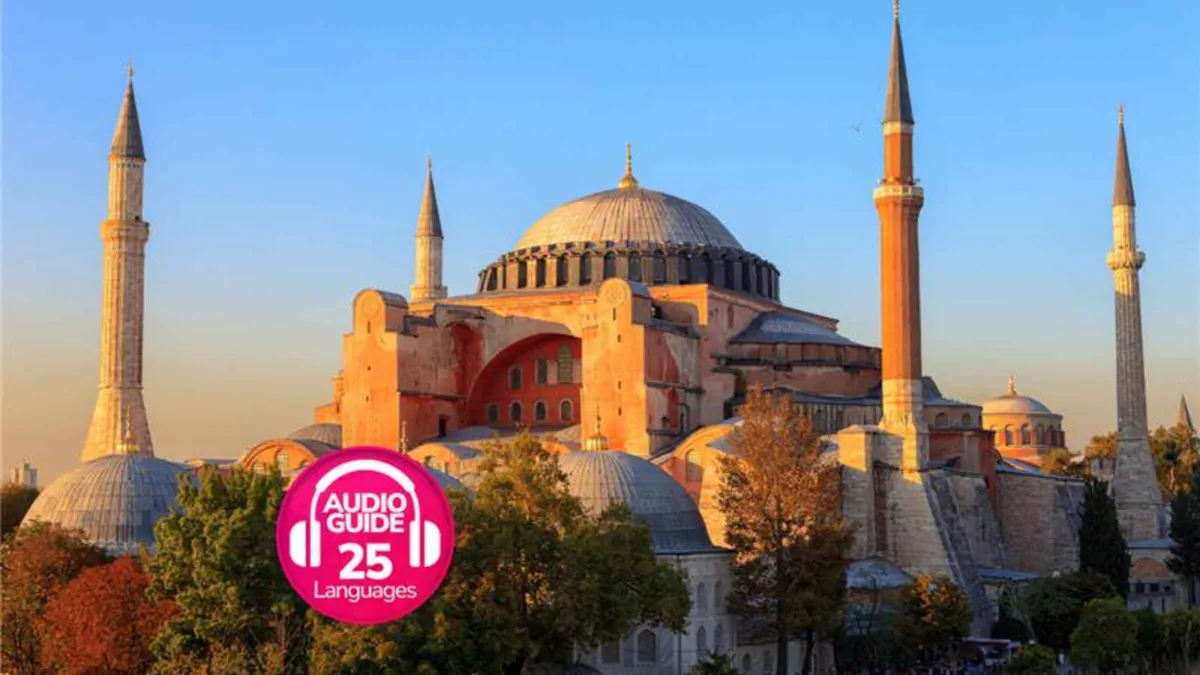 from $39.97
Istanbul: Hagia Sophia Skip-the-Line Ticket
Timed skip-the-line entry to the Hagia Sophia upper gallery, the visitor route since the ground floor returned to worship. The official fare is €25; this listing bundles the queue slot.
Check Availability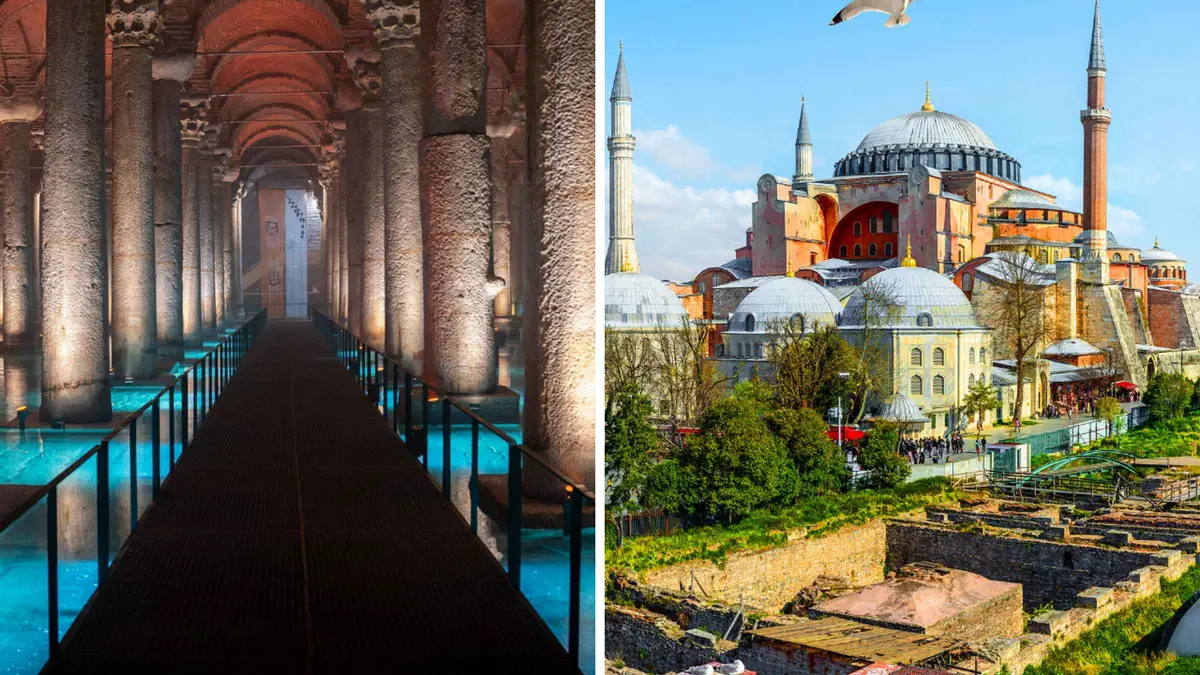 from $98.51
Hagia Sophia &Basilica Cistern Audio Guide +Optional Topkapi
Combo entry for the Hagia Sophia and the Basilica Cistern with audio guides, three-day validity, and Topkapı Palace as an add-on if you want the whole Sultanahmet block in one purchase.
Check Availability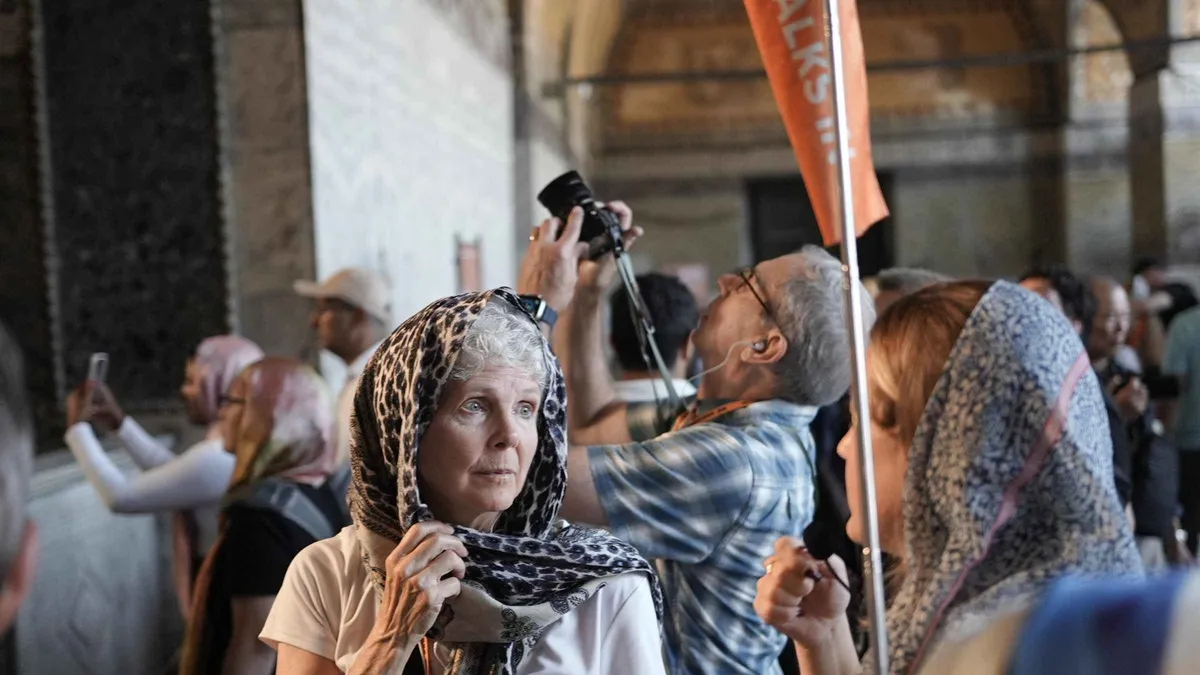 from $56.79
Istanbul: Blue Mosque, Hagia Sophia & Basilica Cistern Tour
Three hours across the Blue Mosque, the Hagia Sophia and the Basilica Cistern with a guide who times the walk around the prayer closures.
Check AvailabilityPrices, ratings and details are the platform's own. Dollar figures are the listed prices. The platform bills in your account's currency.
What to pair it with
Everything below is within a ten-minute walk.
Blue Mosque
Free, across the park, with the same prayer-time pauses: the Blue Mosque.
4 minutes on footBasilica Cistern
Two minutes north, and the one sight in the city with no published price since June 2026: the Basilica Cistern.
3 minutes on footHagia Sophia questions
How much is the Hagia Sophia for tourists?
€25 for foreign visitors, about $29, which admits you to the upper gallery. A fast-track add-on costs a further ₺300. Türkiye citizens with a Müzekart pay ₺625, which the Ministry defines as half the €25 fare converted at the day's rate. The ticket page sets out every option.
What time does the Hagia Sophia close?
Visitors are admitted until 20:00, but the box office closes at 19:00 — the cut-off that catches people who arrive at dusk. Come before 10:00 or after 18:00 for the quietest gallery.
Can non-Muslims enter the Hagia Sophia?
Yes. Visitors of any faith buy the upper-gallery ticket and walk the gallery circuit; the ground floor is reserved for worship. Dress as you would for any mosque: shoulders and knees covered, hair covered for women, shoes off. Mosque etiquette has the detail.
Is the Museum Pass İstanbul valid at the Hagia Sophia?
No, and neither is Müzekart. The Hagia Sophia is sold as its own ticket, which is the single most common reason people find the €105 pass disappointing.
How long do you need inside?
The museum states no figure. Our routing is 45 to 60 minutes: the ramp up, a full circuit of the gallery with time at the Deesis, and the narthex mosaic on the way out. Add queueing time if you arrive between 10:00 and 13:00.
Can Christians visit the Hagia Sophia?
Yes. Visitors of any faith buy the upper-gallery ticket and walk the gallery circuit; the ground floor is reserved for prayer. The Byzantine mosaics, including the Deesis, are on the gallery route.
What is the Hagia Sophia and why is it famous?
A sixth-century Byzantine cathedral whose dome was the largest in the world for nearly a thousand years, converted to a mosque in 1453, made a museum in 1935 and returned to use as a mosque in 2020. It is famous for the engineering of that dome and for the mosaics that survived each conversion.
Why is it called Hagia Sofia?
From the Greek for 'Holy Wisdom' — the church was dedicated to the wisdom of God rather than to a saint named Sophia.
Prices, hours and terms are set by the venue or operator and confirmed at checkout.
We may earn a commission if you book through one of our links, at no extra cost to you. Full affiliate disclosure